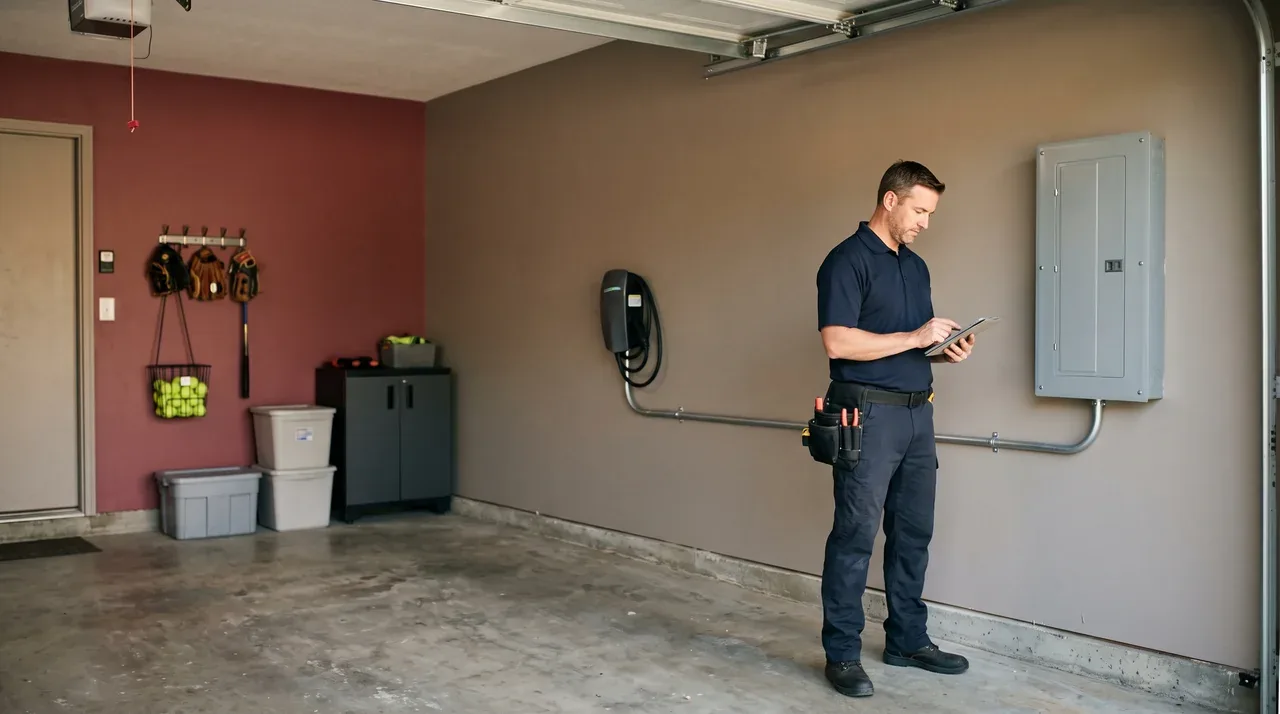
Why consider it?
- Match the charger setting to the home’s actual electrical capacity.
- Discuss compatible load management before assuming a larger service is required.
- Coordinate future loads and charging needs in one review.
Trade-offs & cost
- An empty breaker space is not a load calculation.
- Load management needs compatible equipment and may add components and cost.
- An upgrade, if needed, can affect project price, permits and scheduling.
Request a site-specific quote. See the factors that affect installation cost →
What your electrician reviews
- Existing service and panel information
- Whole-home load review by the electrician
- Vehicle charging needs and equipment compatibility
This is a planning overview. The electrician selects the approved wiring method, circuit protection and installation details; do not alter your panel or wiring from this page.
Compatible EV charger models
This wiring approach does not choose the vehicle connector for you. Have the installer confirm the exact model, approved entry method, circuit and J1772/NACS compatibility.
As an Amazon Associate I earn from qualifying purchases. We may earn a commission from these links.
- Emporia Classic · J1772 on Amazon ↗ — manufacturer-approved hardwired configuration; routing and entry method must be checked.
- ChargePoint Home Flex · J1772 on Amazon ↗ — manufacturer-approved hardwired configuration; routing and entry method must be checked.
- Autel MaxiCharger AC Elite · 50A J1772 on Amazon ↗ — manufacturer-approved hardwired configuration; routing and entry method must be checked.
An enclosure knockout is a wiring entry—not proof that a concealed route is possible. Photos and model names alone cannot establish compatibility.
These are charger candidates, not a guarantee of load-management compatibility. Any energy meter, controller or software must be explicitly supported by the selected model and installer design.