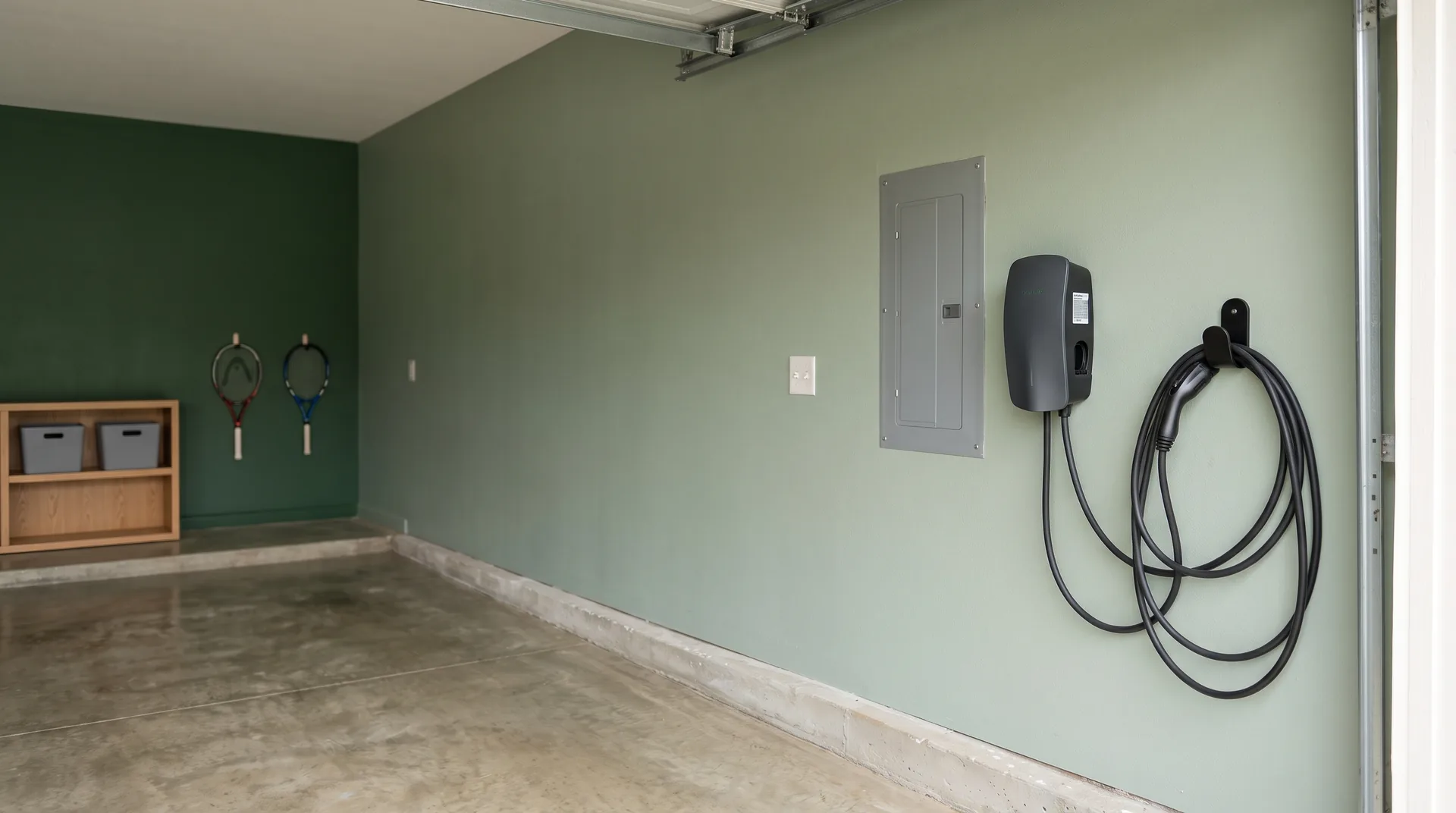
Why consider it?
- A clean wall finish with no surface supply conduit at the charger.
- Can suit new construction, open walls or accessible wall cavities.
- Approved rear-entry equipment can keep the supply connection out of sight.
Trade-offs & cost
- Finished walls may need access openings, patching and repainting.
- Framing, insulation and fire-rated assemblies can limit the route.
- Concealed does not automatically mean less expensive or faster to install.
Request a site-specific quote. See the factors that affect installation cost →
What your electrician reviews
- Accessible and suitable concealed path
- Manufacturer-approved rear wiring entry
- Agreement on who patches, paints and restores wall finishes
This is a planning overview. The electrician selects the approved wiring method, circuit protection and installation details; do not alter your panel or wiring from this page.
Compatible EV charger models
This wiring approach does not choose the vehicle connector for you. Have the installer confirm the exact model, approved entry method, circuit and J1772/NACS compatibility.
As an Amazon Associate I earn from qualifying purchases. We may earn a commission from these links.
- Emporia Classic · J1772 on Amazon ↗ — manufacturer-approved hardwired configuration; routing and entry method must be checked.
- ChargePoint Home Flex · J1772 on Amazon ↗ — manufacturer-approved hardwired configuration; routing and entry method must be checked.
- Autel MaxiCharger AC Elite · 50A J1772 on Amazon ↗ — manufacturer-approved hardwired configuration; routing and entry method must be checked.
An enclosure knockout is a wiring entry—not proof that a concealed route is possible. Photos and model names alone cannot establish compatibility.
Further reading: Manufacturer wiring guidance ↗ChargePoint installation options ↗Emporia configurations ↗
Request a project consultation →